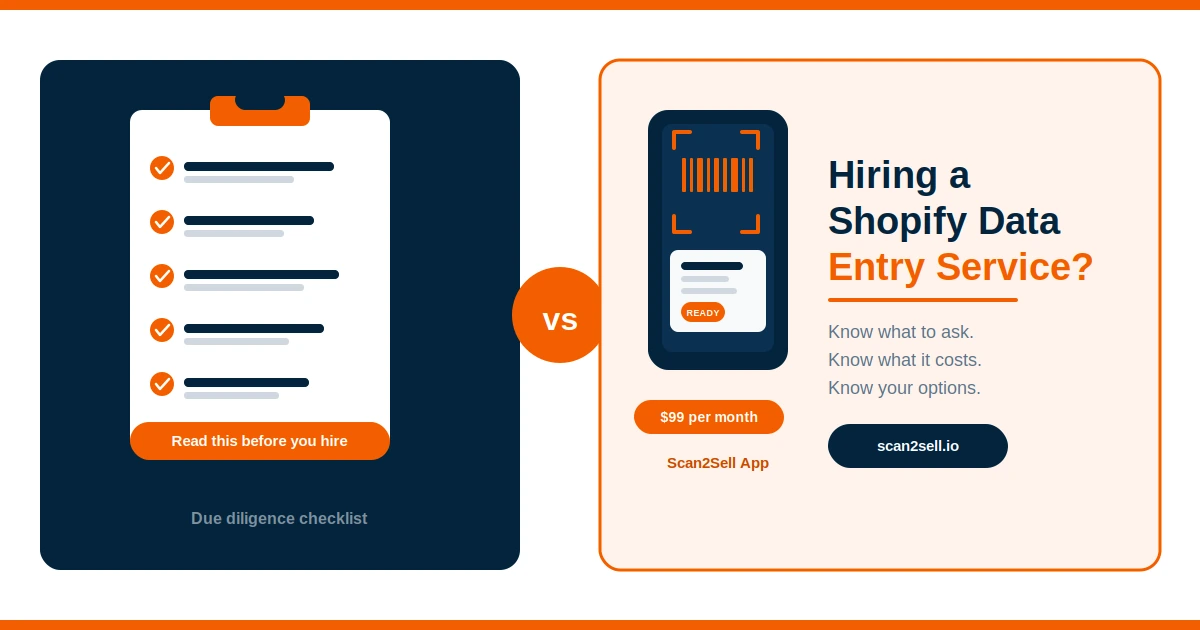
Before you hand your product catalogue to a freelancer or agency, there are a few things worth knowing. Not to talk you out of it — but to make sure you are not paying for something you no longer need.
The Situation Most Merchants Are In
You have a stack of products, a new Shopify store, and the sinking realization that getting everything listed is going to take a long time. Typing each product title, writing descriptions, sorting categories, uploading images — it adds up fast. So the idea of paying someone else to handle it is completely reasonable.
Shopify data entry services exist for exactly this reason, and they do work. But before you commit to one, it is worth understanding what you are actually buying, what it will cost as your inventory grows, and whether the problem you are trying to solve has a more permanent fix available.
What You Are Actually Paying For
When you hire a Shopify data entry service, you are paying for labour. A person or team receives your product information, whether that is a spreadsheet, product photos, or physical packaging shots, and manually enters it into Shopify field by field. The quality of the output depends entirely on the quality of the input you give them and the experience of the person doing the work.
Most services charge per product, typically between $1 and $3 for standard listings. Some charge hourly, which can range from $15 to $40 depending on where the service is based and what level of detail is involved. For a one-time bulk upload of a few hundred products, that pricing can be reasonable. The issue is what happens next.
A data entry service is a one-time fix for a recurring problem. Every time your inventory changes, you are back to the same starting point.
The Questions Worth Asking Before You Hire
Most merchants skip these and regret it later. Before signing up with any service, get clear answers on the following.
Before you hire, ask these:
How do you handle revisions if product details are entered incorrectly?
What is the turnaround time for a batch of 100 products? 500 products?
Do you work directly in my Shopify admin, or do you hand back a CSV?
What happens when I add new inventory next month — is that a new quote?
Who has access to my Shopify store and what permissions do they need?
Can I see examples of Shopify listings you have completed for other retail clients?
Where Services Fall Short for Retail Merchants
For merchants with stable, slow-moving inventory, a data entry service can be a clean solution. Upload once, move on. But most retailers are not in that situation. Products sell, new stock arrives, seasonal items rotate in and out. Each time that happens, you either re-engage the service or absorb the work yourself.
There is also the coordination overhead. You are preparing files, sending briefs, waiting on delivery, then checking the work for errors. That is time you are still spending, just differently. For high-volume or regularly changing inventory, it becomes a dependency rather than a solution.
What Changes When Products Have Barcodes
Here is the part most merchants searching for a data entry service have not come across yet. If your products have barcodes, a significant portion of the data entry work is already done for you the moment you scan.
Apps like Scan2Sell are built for Shopify merchants with physical inventory. Scan a barcode using your phone camera or a Bluetooth handheld scanner, and a structured product listing appears — title, description, category, dimensions, and product images included. You set the price and quantity, review the details, and publish. No waiting, no coordination, no per-product cost.
For products without barcodes, a photo taken on your phone generates a draft listing using the same review and publish workflow. And for large catalogues, a CSV upload handles bulk listings without manual entry for each item.
When Hiring a Service Is Still the Right Call
There are genuine use cases where a data entry service makes more sense than a scanning tool. If your products are handmade, one-of-a-kind, or heavily customized, they likely do not have barcodes and require original copywriting that reflects your brand voice. Antique dealers, artists, and makers with bespoke items often need a person who understands the product, not just a tool that reads a barcode.
Similarly, if you have a legacy catalogue that needs a one-time upload and your inventory barely changes after that, paying a service to handle it once and move on is a sensible decision. The math works differently when you are not dealing with regular stock rotation.
The merchants who end up overpaying for a service are usually the ones selling standard retail products with barcodes, restocking regularly, and paying per product every time new inventory arrives.
Barcoded products list in seconds
Scan with your phone camera or a Bluetooth handheld scanner. A complete listing appears ready for your review before anything is published to your store.
Photo-based listing generation
Take a photo of any product and a draft listing is generated from the image. Same review and publish flow, no barcode required.
Bulk CSV upload
Download the Scan2Sell CSV template, enter your product barcodes, and upload. Listings are generated in bulk without per-item manual work.
Shopify POS integration
Scan2Sell works inside Shopify POS, so you can build listings directly from your store floor without switching between systems.
The Real Cost Calculation
Here is a practical way to think about it. If you are uploading 200 products per month through a data entry service at $2 per product, that is $400 a month, every month, indefinitely. At 500 products a month, you are at $1,000 or more before any revision costs or coordination time is factored in.
Scan2Sell is $99 per month regardless of how many products you scan. For merchants restocking regularly, that difference compounds quickly. For merchants just starting out with a smaller catalogue, it removes the barrier of needing budget approval before adding new products.
Neither option is right for every merchant. But most merchants searching for a data entry service have not done this calculation yet, because they did not know the alternative existed.
Frequently Asked Questions
How do I know if a Shopify data entry service is reliable?
Ask for examples of completed Shopify listings from retail clients similar to your store. Check reviews on platforms like Upwork or Fiverr and confirm their revision policy before committing. A reliable service will be transparent about turnaround time and how errors are handled.
Can I use Scan2Sell if some of my products have barcodes and some do not?
Yes. Scan2Sell supports both barcode scanning and photo-based listing creation. Products with barcodes go through the scan workflow. Products without barcodes use the photo input. Both use the same review and publish process before anything goes live on your store.
Will a data entry service write original descriptions for my products?
Some do, at a higher rate. Most standard data entry services use the product information you provide to populate listing fields rather than writing custom copy. If brand voice and original descriptions matter to your store, clarify this before hiring and expect to pay more for it.
Does Scan2Sell publish listings automatically?
No. Every listing goes through a review step. You can edit the title, description, price, and quantity after the listing is generated. Nothing is pushed to your Shopify store without your approval.
What if I have thousands of products to upload at once?
Scan2Sell's CSV bulk upload is built for this. Download the Scan2Sell CSV template, enter your product barcodes, upload the file back into the app, and listings are generated at scale without manual entry for each product. For ongoing high-volume inventory, this is significantly more cost-effective than a per-product service fee.
See How Fast Your First Listing Comes Together
Scan one product and the listing is ready before you finish the sentence. No data entry required.
Get Scan2Sell — $99/month