Selling records is a passion for many. It's also one of the most labour-intensive to catalog. Every title in your collection has its own artist, album name, label, pressing year, catalogue number, genre, and tracklist.
Multiply that by a few hundred titles and the data entry alone starts to feel like a second job.
If you're running an independent record store, buying and reselling collections, or processing an estate sale that turned up a wall of vinyl, getting everything onto Shopify accurately and quickly matters. This is how barcode scanning fits into a vinyl workflow... and where it doesn't.
Which Records Scan Well
The good news is that a significant chunk of the records you're likely to be selling will have an EAN barcode.
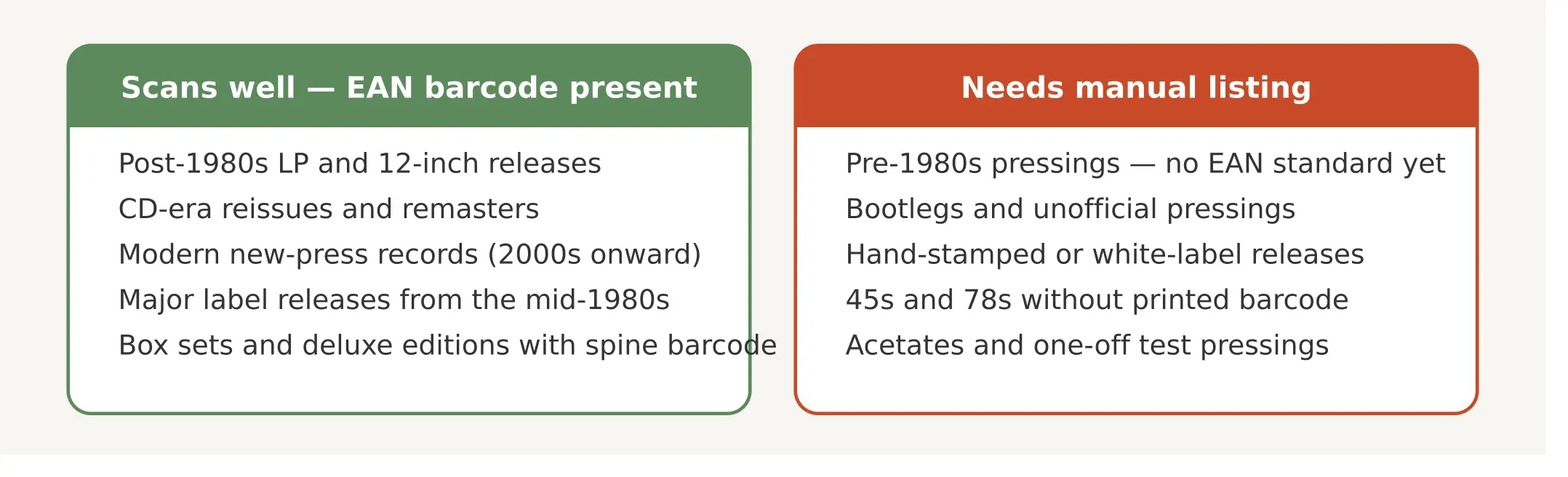
EAN: the European Article Number system became standard for commercial releases through the 1980s and is now universal. If you're handling post-1980s LPs, 12-inches, modern reissues, box sets, or anything pressed from the mid-1980s onward by a major or significant independent label, there's a strong chance that barcode on the outer sleeve or spine is going to work.
When you scan it with Scan2Sell, you're not just getting a product number back. You're getting album title, artist name, record label, release year, genre, and in many cases the ability to include cover art as part of your listing workflow.
What you Get from a Scan, and What you Add Yourself
When a record scans successfully, the draft listing is populated with album title, artist name, cover image, record label, release year, and genre. You review the draft and can edit any field before publishing.
What you always add yourself: condition
No app can grade a record for you. Condition is the most important variable in what a used record is worth, and it requires eyes and hands on the actual copy. Use the standard Goldmine grading scale: Mint (M), Near Mint (NM or M-), Very Good Plus (VG+), Very Good (VG), Good Plus (G+), and Good (G). Add your condition grade to the listing description and factor it directly into your price. Buyers who know records will expect this information front and centre.
What you always add yourself: price
Pricing vinyl is part knowledge, part feel for your market. A VG+ copy of a common 1980s pop album and a VG+ copy of an original soul pressing from the same era are not even in the same conversation. Set your price based on condition, pressing rarity, current demand, and what you know about your customer base. Scan2Sell leaves pricing entirely in your hands.
Handling 45s, 78s, and other formats
Most 7-inch singles (45s) from the 1980s onward have a small EAN barcode printed on the sleeve or label, and they scan the same way as full-length albums. Older 45s and 78s are a different story, barcodes didn't exist when most of them were pressed, so those go in the manual pile.
Picture discs, coloured vinyl, and limited-edition pressings of modern releases usually have barcodes and scan reliably. Box sets almost always do. Live bootlegs, regional-only pressings, and anything from a very small independent label may or may not; check the sleeve and find out.
For 78s specifically, the market is specialist enough that every listing should be written by hand anyway. Buyers of shellac are serious collectors who want pressing details, label design, and condition notes on both the disc and the label itself.
FAQs
Do EAN barcodes on vinyl records actually return useful music data, or just a product number? When a post-1980s record is scanned, the data returned typically includes album title, artist name, record label, release year, and genre; the core information a buyer needs to identify the release. The exact depth of data depends on the specific release and how well it's indexed in the database, but for mainstream and significant independent releases the results are generally solid. You review everything before publishing and can edit any field.
What's the best way to add condition grading to a Shopify vinyl listing? The simplest approach is to include the condition grade in the product title (for example, "Fleetwood Mac — Rumours LP — VG+") and add a more detailed condition description in the product description field. Some record stores also use Shopify's variant feature to list multiple copies of the same title at different grades and prices under a single listing, this works particularly well for common titles you carry regularly.
Can I sell records on Shopify alongside a physical in-store inventory? Yes. Shopify's inventory management tracks stock levels, so if you sell a record in-store you can update or remove the listing manually. If you're running Shopify POS in your store, Scan2Sell integrates with Shopify POS, so your in-store and online inventory can be managed from the same place.
What should I do if a record scans but the data that comes back is wrong, like the wrong pressing or a different region's release? The same EAN barcode is sometimes used across multiple pressings, particularly for international releases and reissues. Always review the draft before publishing. If the data doesn't match your specific copy, edit the fields directly in Scan2Sell before the listing goes live. The draft is a starting point, not a final answer.
Is Shopify a good platform for selling rare or collectable records, or is it better suited to common stock? Shopify works for both, but the approach is different. For common stock, scanning and publishing quickly is the goal. For rare or collectable records, the listing quality matters more than the speed; detailed descriptions, good photos, accurate pressing information, and condition notes are what serious collectors look for. Shopify gives you full control over how a listing looks and reads, which is exactly what high-value record listings need.